Subscribe
HotDocs 2010: Nénette
Monday, May 10th, 2010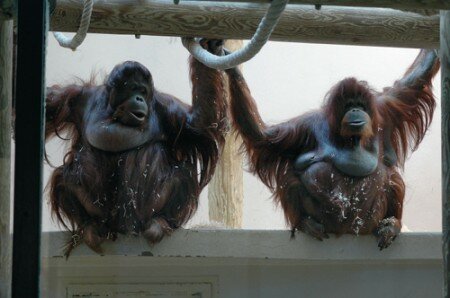
Nicholas Philibert’s Nénette is a 70-minute film in which we constantly observe 40-year-old orangutan, Nénette, and her two orangutan companions, through the glass, in her captive habitat at a Paris zoo. Orangutans live to 30-35 years in the wild, so Nénette is quite old, but Philibert has us questioning, throughout the movie, if those extra years were worth the price of captivity.
Philibert puts us in the place of a visitor to the zoo, constantly gazing at but never interacting with Nénette through the glass. Nénette, for the most part, provides little entertainment, sitting still with a world-wearied expression on her face. Philibert fills the soundtrack with voiceovers of zoo visitors talking about Nénette, watching Nénette, pondering Nénette’s thoughts, and sometimes making absurd assumptions. At seventy minutes, the film feels rather long. We are desperate to see Nénette do something -anything – and in the absence of action, we make up a story about how Nénette must be feeling and thinking, just as the zoo visitors do.
Orangutans share many anatomical similarities to humans such as the hairless face and sunken eyes. But they also have a large lump below the neck; many visitors were fascinated by Nénette’s lump, which is not a breast, but is not comparable to any other part of human anatomy. Visitors gawk at the lump, as do we. The lump’s purpose is not explained until very near the end: it stores a large amount of air, which when appropriately compressed, allows orangutans to let out a very loud noise which can be heard from miles away, to warn other orangutans of danger.
We never hear Nénette make this loud cry; in captivity, she has no need to use it, the zookeeper reminds us. We learn that Nénette has had three mates, and has borne four babies, one of which still resides with her. A few years ago, when Nénette lost her third mate, the zookeepers decided to give her a break and not find her another mate; they keep her son with her for company. However, because they are uncertain of whether incest is forbidden in orangutan society, Nénette is on the birth control pill, which is slipped into her yogurt each day. They want to ensure there is no chance that Nénette will be impregnated by her son and they have no way to tell if she is yet menopausal: menstruation leaves no traces of blood in orangutans, we are told. (more…)



 Last week, BlogUT caught up with Canadian bassist and composer, Brandi Disterheft, for a telephone interview, before her appearance at the Toronto Jazz Festival, as the opening act for the Dave Brubeck Quartet on Canada Day. Her debut album, “Debut”, won the 2008 Juno award for Traditional Jazz Album of the Year, and it’s an impressive debut, with all original compositions, for this very young, late-twenties, up-and-coming artist. Disterheft has studied under Oscar Peterson, who said of her “She has the same lope or rhythmical pulse as my late bass player Ray Brown. She is what we call serious”, and she is currently studying under the great bassist Ron Carter in New York City. Though she is known in the Toronto music scene – her first album was made with all Toronto musicians – she has decided to take on the big apple, where she now lives, and enjoys the new anonymity and late-night jam sessions at various clubs. She has been doing a lot of touring across Canada in the last week from Calgary to BC to Toronto, playing shows with her newly assembled sextet.
 Although the great jazz saxophonist Sonny Rollins (78), master pianist Dave Brubeck (88), and virtuoso double bassist Charlie Haden (71) may be senior citizens, they play as if they’re still young, and what a show they each put on in the last week during the Toronto Jazz Festival. Their sets may have been short, but every minute counted, and every minute was top notch.